Pulling the trigger and moral agency
The GuiltyPulling the trigger and moral agency centers on the widening gap between Will Robie’s professional command of lethal force and his ability to accept what that force has done. The trigger is at once a practiced physical action and a threshold with consequences no official classification can undo. After Robie kills a child, he condemns himself; on a later mission, an apparent child in his sightline prevents him from firing. The reversal does not restore his confidence. Instead, it makes his own perception and judgment uncertain, leaving him to question whether he can still perform the work that has defined him.
Training, Responsibility, and the First Failure
Robie’s crisis begins with a killing he did not intend but cannot separate from his own responsibility. A little girl with curly dark hair dies during a mission, and the message he receives describes her as the target’s daughter and classifies her death as collateral damage. That label may describe the operation’s official accounting, but it does not alter the fact that she is dead. Robie’s attention fixes not on the classification but on her face and on the circumstance that she was running to her father as he died. The language of procedure and the reality of the child’s death stand in direct opposition.
The killing also reopens an earlier moment when Robie came close to killing a child but did not pull the trigger. That earlier refusal nearly cost him his career and his life; now, in a different mission, the shot has been fired and a child is dead. The contrast makes the act more than a professional mistake. Robie’s own judgment holds him answerable even where the death was unintentional, and he repeats the accusation to himself in increasingly direct terms: the girl is dead because of him. His remorse is not presented as a question of whether he can find an excuse. It is a question of how he can continue to act with lethal authority while living with the consequence of an action he cannot reverse.
The Trigger as a Test of Self-Trust
After the child’s death, Robie looks down at his trigger finger, callused by years of practice, and wonders whether he has reached the point at which he must walk away. The trained hand is tangible evidence of a competence built through repetition, but it cannot settle whether he should continue using that competence. The trigger finger therefore carries two meanings at once: it is the instrument of his professional skill and the part of himself through which an irreversible choice becomes action.
Yet Robie responds to the crisis by demanding another opportunity to fire. He tells Blue Man that he needs to return to the field quickly and pull the trigger again; when Blue Man questions whether that is advisable, Robie insists that this is what he does and that, without it, he is nothing. His demand exposes a contradiction rather than resolving one. The first death makes him question his fitness, but he seeks renewed action as proof that he remains capable. His sense of identity is so tightly bound to performing the task that abstaining from it seems to him like losing the self that can do anything at all. The urgency of that belief does not establish that another mission will heal him; the narrative instead shows how urgently he wants it to.
The Shot He Cannot Take
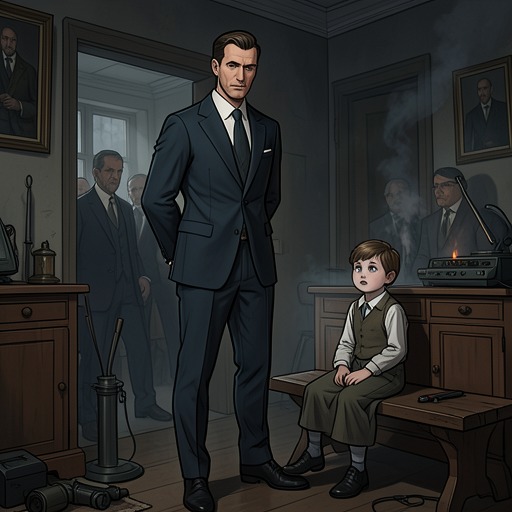
On the next mission, Robie is positioned to fire at a man. As his finger moves toward the trigger, he sees a little boy run to the man and ask to be picked up. The man takes the child into his arms. Robie freezes with his finger a millimeter from the trigger because taking the shot would mean killing the child as well. A voice in his ear urges him to fire, but the command does not make his hand move. A shot rings out, and the man falls mortally wounded; Robie then looks down and realizes that his finger never touched the trigger. Randy Gathers is already pulling him to his feet as the order to leave comes through his earpiece.
The apparent refusal might look like a recovered moral boundary: faced with a child in the line of fire, Robie does not shoot. But he later understands that the boy was not there. On the Arlington Memorial Bridge, he recognizes that he had seen Sasha, the girl he killed, and changed her in his mind: he had made her a boy, moved her far away, and given her another father. He also realizes that his scope had been aimed above the man’s head, a discrepancy that should have alerted him to what was happening. The scene thus unsettles any simple reading of the frozen finger as a deliberate, reliable act of restraint. Robie did not knowingly spare a real child; his perception supplied a child who was absent, and the shot was fired without his finger pulling the trigger.
Consequences for Work and Identity
The mission leaves Robie unable to rely on the perception on which his profession depends. His hands tremble, and he recognizes that what he took to be a child in the room was a hallucination—an unprecedented experience for him. He had expected cold zero, but it never came. Officially, he is placed on leave until he can sort out what is happening in his head; he will not return to the field in the meantime. The consequences are practical as well as inward: a marksman who cannot trust what he sees cannot confidently determine when a shot is justified or whether the target picture is real.
His later account to Daniel Robie gathers the two failures into a single confession. Robie says that on his last two missions he was far from perfect: he killed someone he should not have, then saw a boy and an old man who were not there. He cannot finish explaining himself smoothly, despite having thought through what to say. The broken delivery mirrors the problem he is trying to describe: deliberate preparation cannot guarantee command over the mind or over what comes out of it. Meanwhile, his father’s murder charge has brought him back to a past he had left unaddressed. Robie sees that return as necessary to going forward, but it does not erase the professional crisis that brought his confidence into question.
Moral Agency and the Limits of Control
The two missions place Robie on opposite sides of the trigger and deny him an easy definition of control. In the first, he fires and a child dies, though he did not intend her death. In the second, he cannot fire because he perceives a child beside his target, but the child is an image generated by his own mind, and the shot comes from elsewhere. The contrast separates physical action from the fuller work of agency: aiming and firing are not enough if perception is compromised, while the absence of a finger’s pressure does not by itself resolve who acted or what the action means.
Robie’s deepest loss is consequently not only his place in the field but confidence in himself as the person who can decide and act. He fears that his mind may mislead him again, and that fear reaches the foundation of his professional identity. The child’s face recurs across both missions, first as the consequence of a shot and then as a presence that stops his hand. That recurrence links guilt to hesitation without making one a cure for the other. The concept’s central tension is that responsibility cannot be escaped through the language of collateral damage, yet action cannot be trusted merely because it is trained. For Robie, the trigger becomes a test not of whether he can fire, but of whether he can know what he is doing when he does.